Lack & Transcendence by David R. Loy
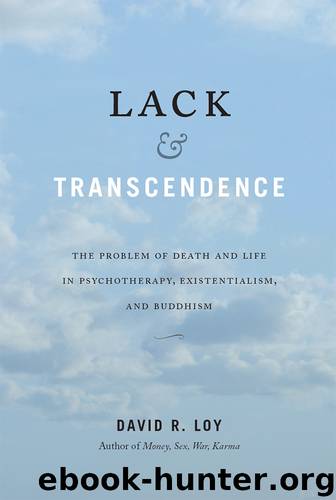
Author:David R. Loy
Language: eng
Format: epub
Publisher: Wisdom Publications
4
THE MEANING OF IT ALL
WHAT DOES THE SELF-AS-LACK imply about ethical values, the search for truth, and the meaning of our lives? To raise these issues in the Western tradition is to find ourselves in a dialogue with Nietzsche, the first (and still the most important) postmodernist, whose own texts resonate with many of the same concerns. Nietzsche realized that morality, knowledge, and meaning are not discovered but constructed: internalized games we learn from each other and play with ourselves. Perhaps the history of his own psyche reveals how momentous these discoveries were. Inevitably his perceptions (like those of Freud and other intellectual revolutionaries) were somewhat distorted.
Nietzsche understood how the distinction we make between this world and a “higher” spiritual realm serves our need for security, and he saw the bad faith in religious values motivated by this anxiety. But he did not understand how his alternative, more aristocratic values, also reflects the same anxiety. Nietzsche ends up celebrating an impossible ideal, the heroic ego that overcomes its sense of lack, because he does not see that a heroic ego is our fantasy project for overcoming lack.
Nietzsche realized how the search for truth is motivated by a sublimated desire for symbolic security; again, his solution reverses our usual dualism by elevating ignorance and “untruth” into conditions of life. Philosophy’s attempt to create the world reflects the tyrannical will-to-power, becoming the most “spiritualized” version of the need to impose our will. But insofar as truth is our intellectual way to grasp being symbolically, those who no longer need to ground themselves can play the truth-versus-error game with lighter feet. Like Schopenhauer, Nietzsche overlooks a different reversal of perspective that could convert the bad infinite of heroic-will into the good infinite of truth-as-play.
What he considered the crown of his system — eternal recurrence — is actually its denouement. Having seen through the delusion of Being, Nietzsche could not let it go completely, for he still sought a Being within Becoming. “To impose upon becoming the character of being — this is the supreme will to power. . . . That everything recurs is the closest approximation of a world of becoming to a world of being.”188 This may have been his self-conscious attempt to create a myth that might liberate us not from but into this world. If so, it does not liberate us enough. Having exposed the bad faith of believing in eternity, Nietzsche is nonetheless able to affirm the value of this moment only by making it recur eternally. In place of the neurotic’s attempt to rediscover the past in the future, he tries to rediscover the present in the future, yet (the basic problem) the eternal recurrence of the now can add something only if the now in itself lacks something.
Rather than the way to vanquish nihilism, Nietzsche’s will-to-power turns out to be pure nihilism, for its eternal recurrence would ensure that our flight from lack could have no cloture. This is because nihilism is not the debacle of
Download
This site does not store any files on its server. We only index and link to content provided by other sites. Please contact the content providers to delete copyright contents if any and email us, we'll remove relevant links or contents immediately.
Rewire Your Anxious Brain by Catherine M. Pittman(18622)
Talking to Strangers by Malcolm Gladwell(13332)
The Art of Thinking Clearly by Rolf Dobelli(10383)
Mindhunter: Inside the FBI's Elite Serial Crime Unit by John E. Douglas & Mark Olshaker(9299)
Becoming Supernatural by Dr. Joe Dispenza(8186)
Change Your Questions, Change Your Life by Marilee Adams(7718)
Nudge - Improving Decisions about Health, Wealth, and Happiness by Thaler Sunstein(7678)
The Road Less Traveled by M. Scott Peck(7574)
The Lost Art of Listening by Michael P. Nichols(7480)
Mastermind: How to Think Like Sherlock Holmes by Maria Konnikova(7304)
Enlightenment Now: The Case for Reason, Science, Humanism, and Progress by Steven Pinker(7288)
Win Bigly by Scott Adams(7172)
The Way of Zen by Alan W. Watts(6578)
Daring Greatly by Brene Brown(6489)
Big Magic: Creative Living Beyond Fear by Elizabeth Gilbert(5726)
Grit by Angela Duckworth(5577)
Ego Is the Enemy by Ryan Holiday(5392)
Men In Love by Nancy Friday(5218)
The Laws of Human Nature by Robert Greene(5136)
